Making the case for High Tech + High Touch.
1. What is Physical Interaction?
Based on Bret Victor’s Brief Rant on the Future of Interaction, Physical Interaction happens when “a tool that addresses human needs amplifies human capabilities.”
What is missing in this idea of the future of interaction, aside from a lack of vision or inspiration, is that it veers away from the natural gestures that our bodies are capable of. Case in point, your hands and the many gestures it can do based on intuition – opening jars, holding a hammer, reading a book, and our capacity to “improvise from it constantly without the slightest thought.” He emphasizes this on his argument about sliding gestures on touch screens in “Pictures Under Glass.”
“Pictures Under Glass is an interaction paradigm of permanent numbness. It’s a Novocaine drip to the wrist. It denies our hands what they do best.”

What struck a chord in Bret Victor’s rant is the fact that Pictures Under Glass isn’t an impressive enough idea to maximize human capabilities. He even compared that settling for touch screens as the “FUTURE” is akin to accepting that black-and-white as the future of photography. The revolution doesn’t stop at Apple’s foray into touch screens, as Physical Interaction is still transitioning to something more towards the NUI (Natural User Interface) versus GUI (Graphical User Interface). He argues that slide gestures of the hands rarely happen in real life.
There is almost nothing in the natural world that we manipulate in this way.
That’s pretty much all I can think of.
Okay then, how do we manipulate things? As it turns out, our fingers have an incredibly rich and expressive repertoire, and we improvise from it constantly without the slightest thought.

2. What makes for good physical interaction?
In “Don’t make me Think” by Steve Krug, I’ve learned another UX design rule of thumb. Good design is invisible that the experience should be a seamless interaction for users. This is less about a minimalist aesthetic and more about ease of use, learnability and error handling to provide a frictionless experience.
3. Are there works from others that you would say are good examples of digital technology that are not interactive?
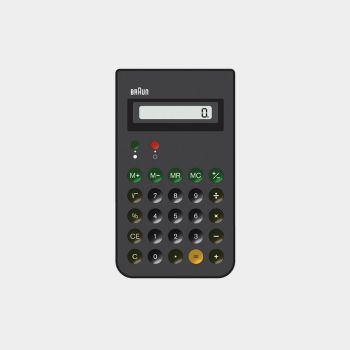
I’ve always been fascinated with the products designed by Dieter Rams, a german industrial designer and Chief Design Officer of Braun, who is also known for his “less is better” aesthetic. In the 70’s, he was concerned about the state of the world being “an impenetrable confusion of forms, colours and noises.” Hence, the 10 Principles of Good Design was born.
Dieter Rams 10 Principles of Good Design:
- Good design is innovative. The possibilities for innovation are not, by any means, exhausted. Technological development is always offering new opportunities for innovative design. But innovative design always develops in tandem with innovative technology, and can never be an end in itself.
- Good design makes a product useful. A product is bought to be used. It has to satisfy certain criteria, not only functional, but also psychological and aesthetic. Good design emphasizes the usefulness of a product whilst disregarding anything that could possibly detract from it.
- Good design makes a product understandable. It clarifies the product’s structure. Better still, it can make the product talk. At best, it is self-explanatory.
- Good design is aesthetic. The aesthetic quality of a product is integral to its usefulness because products we use every day affect our person and our well-being. But only well-executed objects can be beautiful.
- Good design is unobtrusive. Products fulfilling a purpose are like tools. They are neither decorative objects nor works of art. Their design should therefore be both neutral and restrained, to leave room for the user’s self-expression.
- Good design is honest. It does not make a product more innovative, powerful or valuable than it really is. It does not attempt to manipulate the consumer with promises that cannot be kept
- Good design is long-lasting. It avoids being fashionable and therefore never appears antiquated. Unlike fashionable design, it lasts many years – even in today’s throwaway society.
- Good design is thorough down to the last detail. Nothing must be arbitrary or left to chance. Care and accuracy in the design process show respect towards the user.
- Good design is environmentally-friendly. Design makes an important contribution to the preservation of the environment. It conserves resources and minimizes physical and visual pollution throughout the lifecycle of the product.
- Good design is as little design as possible. Less, but better – because it concentrates on the essential aspects, and the products are not burdened with non-essentials. Back to purity, back to simplicity.

 Happy Path Journeys